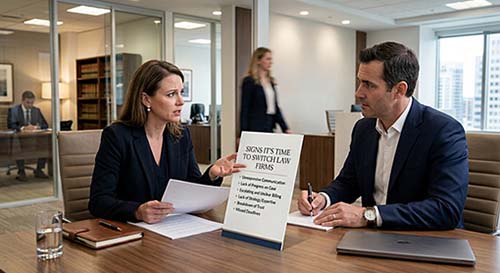
How Do You Know If It’s Time to Switch Law Firms?
Recurring missed deadlines, unreturned calls, and a case that has outgrown the attorney’s experience are common signs it may be time to switch law firms. Howard Fensterman notes that a new firm can request the case file and review key deadlines so the transition does not result in lost ground or a missed filing.
What Are the Warning Signs You Need a New Lawyer?
Choosing a firm and staying with the right one are two different questions. A firm that was a reasonable choice at the outset can still stop being the right fit as a case evolves, and a single frustrating phone call is not a reason to switch. A pattern is. Watch for these signals over time:
- You cannot get a straight answer. Calls and emails go unreturned for days, or updates arrive only when you chase them down.
- Deadlines slip without explanation. A missed filing, a blown response date, or a court date you learned about too late are not minor lapses; they can permanently damage a case.
- The matter has outgrown the attorney’s experience. A case that started simply has turned into a regulatory investigation, a multi-party dispute, or a specialized area the firm rarely handles.
- Your case keeps changing hands. Either the attorney you hired has left the firm, or your file has been reassigned more than once, and no one currently handling it knows the history well.
- The strategy stopped making sense to you. Not every legal decision needs to be popular, but you should understand the reasoning. If explanations feel evasive rather than complicated, that is different from a hard case.
- Billing surprises keep happening. Invoices do not match what was discussed, or the firm cannot clearly explain what you are being charged for.
- A conflict of interest surfaces after the fact. You learn the firm represents, or has represented, an opposing party, a business partner, or someone with interests that run against yours.
Many of these concerns correspond with duties addressed in the New York Rules of Professional Conduct, including diligence, communication with clients, reasonable and clearly explained fees, and the avoidance or proper disclosure of conflicts of interest. Any one of these, on its own, might have an innocent explanation. Several together, especially deadlines and communication, are the pattern worth acting on.
Is the Problem Fixable, or Is It Time to Switch?
Not every frustration means you need a new firm. Before deciding, it is worth having one direct conversation. Ask specifically why a deadline was missed, why a call was not returned, or why a strategy changed. A firm that responds with a clear, specific answer and a concrete plan to fix the issue may simply need a course correction. A firm that responds defensively, vaguely, or not at all is telling you something important about how the rest of the case will go.
The distinction that matters most is whether the problem is about a single person or the firm’s underlying capacity. An attorney having a bad week on an otherwise well-run file is different from a firm that is structurally too thin, too generalist, or too disorganized to handle your matter well.
Can You Switch Law Firms in the Middle of a Case?
Yes. Clients have the right to change legal representation at essentially any point in a matter, including mid-litigation. In most circumstances, a new attorney can be substituted in without a hearing, through a simple consent form signed by the outgoing and incoming attorneys. In matters already before a court, a judge’s approval for the substitution is sometimes required, particularly close to a trial date, but this is a routine and well-established process, not a rare exception. New York Courts provide an official Consent to Change Attorney form for documenting the substitution of outgoing and incoming counsel in an active matter.
How Do You Switch Law Firms Without Hurting Your Case?
Switching firms carries risk only when it is done carelessly. Handled properly, it does not have to cost you ground.
Start by requesting your complete case file in writing before you formally end the relationship; you are entitled to it. Identify all upcoming deadlines, court dates, and statutes of limitations before you make the switch, since a gap in coverage during the transition is the single biggest risk. A new firm should confirm it has reviewed those dates and has the capacity to meet them before it agrees to take over. Where a matter is already in litigation, the outgoing and incoming attorneys typically coordinate a substitution of counsel so the case record stays intact and nothing falls through during the handoff.
What Happens to Fees and Retainers When You Switch?
The outgoing firm is generally entitled to be paid for work already performed, either from time already billed against a retainer or on a quantum meruit basis for the value of services rendered, and any unearned portion of a retainer is typically refundable. The new firm should explain its own fee structure clearly before you sign anything, so you are not layering an unclear new arrangement on top of an unresolved old one. Fee disputes with an outgoing firm are common enough that it is worth resolving them in writing rather than leaving them open while a new firm takes over.
Choosing Where to Land
Deciding it is time to leave a firm is only half the decision. The other half is choosing where to go next. Readers can begin by reviewing what makes a great law firm in 2026 and learning why choosing the right law firm matters when legal strategy, communication, cost, and outcomes are at stake.
Frequently Asked Questions
Can I switch law firms in the middle of a case?
Yes. Substitution of counsel is a routine process, though a judge’s approval may be required in an active litigation matter, particularly close to trial.
Will switching lawyers delay my case?
It can, if deadlines are not identified and confirmed before the switch. A properly managed transition, with the case file requested early and key dates confirmed with the new firm, minimizes delay.
Do I get my retainer back if I switch firms?
Any unearned portion of a retainer is typically refundable. The outgoing firm is generally entitled to payment for work already performed.
What is the first sign that it might be time to switch?
A pattern of missed communication or missed deadlines, rather than a single incident, is usually the clearest early signal.
Is a conflict of interest a valid reason to switch firms?
Yes. A conflict discovered after you have already engaged a firm is a serious issue and a legitimate reason to seek new counsel.
Attorney Advertising. Prior results do not guarantee a similar outcome.